Xem trước nội dung
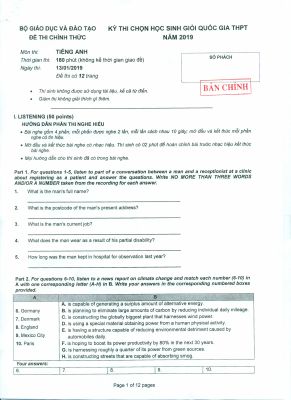
III. READING (50 points)
Part 1. For questions 46-55, fill each of the following numbered blanks with ONE suitable word. Write
your answers in the corresponding numbered boxes provided.
COLLAPSE OF THE EMPIRES
Historians have long been puzzled by the demise of the Akkad culture of central Iraq around 4000 years
ago. Not to mention the simultaneous disappearance of the Egyptian kingdom following the building of the great
pyramids, together with hundreds of (46) settlements in the Holy Land. In 2001, satellite images of
southern Iraq revealed what appears to be a relatively recent 3km-wide impact crater, suggesting that the
Middle East was (47) by a meteor which blasted the area (48) the violence of hundreds of H-
bombs.
Around 3600 years ago, settlements on the volcanic Mediterranean island of Thera were annihilated by a
titanic (49) . The aftermath, which included a large tsunami, is believed to have triggered the collapse of
the famed Minoan (50) on Crete.
Many researchers believe the civilization of Atlantis met its (51) around 12,000 years ago. lf so, this
could link Atlantis to perhaps the most famous catastrophe of them all: Noah's flood. Accounts of a catastrophic
flood that devastated the whole world (52) up in the mythology of many (53) cultures, from
Mexico to China. They may all be references to the devastation caused by the 100-meter rise in sea-level that
followed the (54) Of the ice sheets around 10,000 years ago. Geological studies suggest the
Mediterranean (55) through into the Black Sea, inundating the whole area. At the time, it would truly
have seemed as if the whole world had been flooded.
Your answers:
46. 47. 48. 49. 50.
B §2. 53. 54. 55.
Part 2. Read the following passage and do the tasks that follow.
SGCIENTIFIC MANAGEMENT IN THE WORKPLACE
The car and computer manufacturing plants, the work environments we go to every day, the hospitals we
are treated in, and even some of the restaurants we might eat in all function more efficiently due to the
application of methods that come from Scientific Management. In fact, these methods of working seem so
commonplace and so logical to a citizen of the modern world that it is almost impossible to accept that they
were revolutionary only 100 years ago.
Scientific Management was developed in the first quarter of the 20” century; its father is commonly
accepted to be F.W. Taylor. Taylor recognized labor productivity was largely inefficient due to a workforce that
functioned by “rules of thumb.” Taylor carried out studies to ensure that factual scientific knowledge would
replace these traditional “rules of thumb.” The backbone of this activity was his “time-and-motion" study. This
involved analyzing all the operations and the motions performed in a factory, and timing them with a stopwatch.
By knowing how long it took to perform each of the elements of each job, he believed it would be possible to
determine a fair day's work.
Work, he contended, was more efficient when broken down into its constituent parts, and the management,
planning, and decision-making functions had been developed elsewhere. As this implies, Taylor viewed the
majority of workers as ill-educated and unfit to make important decisions about their work.
Taylors system ensured the most efficient way would be used by all workers, therefore making the work
process standard. Invariably, managers found that maximal efficiency was achieved by a subdivision of labor.
This subdivision entailed breaking the workers' tasks into smaller and smaller parts. In short, he specified not
only what was to be done, but also how it was to be done and the exact time allowed for doing it.
One theory based on the Scientific Management model is Fordism. This theory refers to the application of
Henry Ford's faith in mass production ~ in his case, of cars —- and combined the idea of the moving assembly
line with Taylors systems of division of labor and piece-rate payment. With Fordism, jobs are automated …
Trên đây là phần đầu tài liệu — bấm Đọc sách để xem đầy đủ.

.png "10 đề thi Thử TN THPT 2021 Tiếng Anh theo đề Minh Họa Có Lời Giải Chi tiết và Đáp Án (bộ 2)")