
Xem trước nội dung
Nguồn: Tham khảo, trích dẫn của nhiều giáo viên và download.
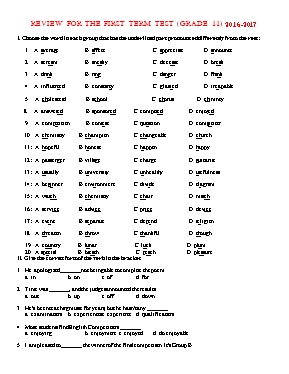
REVIEW for the first term test (Grade 11) 2016-2017
UNIT 1: Infinitive with TO and Infinitive without TO
Động từ nguyên mẫu có TO và không TO
1. Infinitive with TO :
+ is used to express a purpose. Ex : I’m learning English to get a good job.
+ is used after adjectives Ex : I’m pleased to see you.
+ is used after interrogative pronouns : what, who, where, how, ...
Ex : Tell me what to do.
+ is used after indefinite pronouns : something, nothing, anybody,…
Ex : He has nothing to do.
+ is used after some verbs : want, need, decide, refuse, offer, hope, fail, agree, tend, plan, arrange, learn, promise, afford, care, manage, attempt, ... Ex : I want to buy that house.
2. Infinitive without TO
+ is used after some verbs : make, let ; and see, hear, watch, feel,… + Object
Ex : Nothing can make him cry.
I saw the man get into the car.
+ is used after modal verbs: will, shall, could, can , should, must, may,…
Ex: I must speak to manager .
You should go to bed early.
+ is used after : and, or, except, but, than, as, like… Ex: He cannot do anything but smile.
BÀI TẬP:
* Exercise 1: Put the verbs in brackets in the correct form:
1. He expects (receive) ___________ her reply today.
2. We hope (see) __________ each other next summer.
3. She promised (not be) ____________ there again.
ThuVienDeThi.com
4. I want (see) ____________ the house where our president was born.
5. He told me (try) ___________ (come) __________ early.
* Exercise 2: Rewrite the sentences, using the words given in brackets:
1. They arrived home late. (He saw)
2. She didn’t want to stay there for the weekend. (They made her).
3. The teacher allowed me to stay at home to finish the assignment. (The teacher let)
4. The boy ran away from the house. (She noticed)
5. The policeman told the thief to empty his pockets. (The policeman made)
UNIT 2:
TENSES (THÌ)
Thì
Dạng
SIMPLE PRESENT
(Hiện Tại đơn)
SIMPLE PAST
(Quá Khứ đơn)
Khẳng định S + V [-s/-es] S + V-ed / 2
Phủ định S + don’t / doesn’t + V(bare-inf) S + didn’t + V(bare-inf)
Nghi vấn Do / Does + S + V (bare- inf) …? Did + S + V(bare-inf) …?
Bị động …am / is / are + V-ed/Vpp… …was / were + V-ed/Vpp…
Nhận biết
- always, usually, occasionally, often, …
- every : every day, every year…
- once…, twice…, 3 times…
- yesterday
- last : last week, last Sunday…
- ago : two months ago, five years ago…
- in the past
Thì
Dạng
PAST PERFECT (Qúa Khứ hoàn thành)
PAST CONTINUOUS
(Quá Khứ tiếp diễn)
Khẳng định S + had + V-ed/Vpp S + was / were + V-ing
Phủ định S + hadn’t + V-ed/Vpp S + wasn’t / weren’t + V-ing
ThuVienDeThi.com
Nghi vấn Had + S + V-ed/Vpp…? Was / Were + S + V-ing …?
Bị động …had been + V-ed/Vpp… …was / were + being + V-ed/Vpp…
Nhận biết
- after + (past perfect), (simple past)
- before + (simple past), (past perfect)
- by the time/when ( Vpast), Had + Vpp
- At that moment
- When / As + (simple past):
When I came, she was crying.
- While :
A dog crossed the road while I was driving.
Khi chia động từ cần chú ý sự hòa hợp của chủ ngữ (S) và động từ (V):
* S1 + and + S2 => số nhiều. Ví dụ : Tom and Mary were late yesterday.
* Each, every, no + noun => số ít. Ví dụ : Each boy and girl has a textbook. No student is present
* (N)either + S1 + (n)or + S2 => chia theo S2. Ví dụ : He or you are the best student.
* S1, as well as + S2 => chia theo S1. Ví dụ : John, as well as you, is responsible for that report.
* Chủ ngữ là danh từ chỉ đo lường, giá cả, tiền => số ít. Ví dụ : 5,000 dollars is a big sum of money.
* Đại từ bất định (everyone, something, nobody…) => số ít. Ví dụ : Everybody is in the room.
BÀI TẬP
1. I (see) __________ her last year
2. You (watch) ____________ TV last night?
3. I (do) _____________ my homework at 7 p.m yesterday.
4. Before she (watch)___________ TV, she (wash) _____________ her clothes.
5. The light (go) __________ out while we (have) _____________ dinner.
6. …
Trên đây là phần đầu tài liệu — bấm Đọc sách để xem đầy đủ.