Xem trước nội dung
1
TRƯỜNG ĐẠI HỌC VINH TRƯỜNG THPT CHUYÊN
(Đề thi có 05 trang)
ĐỀ THI KSCL LỚP 12 THEO ĐỊNH HƯỚNG THI TN THPT VÀ XÉT TUYỂN ĐH NĂM 2021 - LẦN 2
Môn thi: TIẾNG ANH Thời gian làm bài: 60 phút, không kể thời gian phát đề
Họ, tên thí sinh: ……………………………….., Số báo danh: ………………………………..
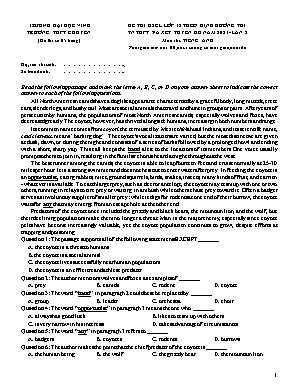
Read the following passage and mark the letter A, B, C, or D on your answer sheet to indicate the correct answer to each of the following questions.
All North American canids have a doglike appearance characterized by a graceful body, long muzzle, erect ears, slender legs, and bushy tail. Most are social animals that travel and hunt in groups or pairs. After years of persecution by humans, the populations of most North American canids, especially wolves and foxes, have decreased greatly. The coyote, however, has thrived alongside humans, increasing in both numbers and range.
Its common name comes from coyotl, the term used by Mexico's Nahuatl Indians, and its scientific name, canis latrans, means “barking dog”. The coyote's vocalizations are varied, but the most distinctive are given at dusk, dawn, or during the night and consists of a series of barks followed by a prolonged howl and ending with a short, sharp yap. This call keeps the band alert to the locations of its members. One voice usually prompts others to join in, resulting in the familiar chorus heard at night throughout the west.
The best runner among the canids, the coyote is able to leap fourteen feet and cruise normally at 25-30 miles per hour. It is a strong swimmer and does not hesitate to enter water after prey. In feeding, the coyote is an opportunist, eating rabbits, mice, ground squirrels, birds, snakes, insects, many kinds of fruit, and carrion - whatever is available. To catch larger prey, such as deer or antelope, the coyote may team up with one or two others, running in relays to tire prey or waiting in ambush while others chase prey toward it. Often a badger serves as involuntary supplier of smaller prey: while it digs for rodents at one end of their burrow, the coyote waits for any that may emerge from an escape hole at the other end.
Predators of the coyote once included the grizzly and black bears, the mountain lion, and the wolf, but their declining populations make them no longer a threat. Man is the major enemy, especially since coyote pelts have become increasingly valuable, yet the coyote population continues to grow, despite efforts at trapping and poisoning. Question 1: The passage supports all of the following statements EXCEPT _______.
A. the coyote is a threat to humans B. the coyote is a social animal C. the coyote lives successfully near human populations D. the coyote is an efficient and athletic predator Question 2: The author mentions wolves and foxes as examples of _______.
A. prey B. canids C. rodent D. coyote Question 3: The word “band” in paragraph 2 could best be replaced by _______.
A. group B. leader C. orchestra D. choir Question 4: The word “opportunist” in paragraph 3 means the one who _______.
A. always has good luck B. likes to team up with others C. is very narrow in his interests D. takes advantage of circumstances Question 5: The word “any” in paragraph 3 refers to _______.
A. badgers B. coyotes C. rodents D. burrows Question 6: The author makes the point that the chief predator of the coyote is _______.
A. the human being B. the wolf C. the grizzly bear D. the mountain lion
DeThi.edu.vn
Trên đây là phần đầu tài liệu — bấm Đọc sách để xem đầy đủ.

.jpg "Bộ đề thi thử môn Tiếng Anh THPT 2026 mới nhất (Có lời giải)")